Before We Look for Answers, We Need the Right Question.
One of my favorite scenes in Moneyball takes place in the Oakland Athletics' scouting room.
The scouts are debating players based on traditional, romanticized metrics—praising a player's swing, appearance, or confidence. Billy Beane interrupts, pointing to the raw statistics and asking: "If he can hit, why doesn't he hit?"
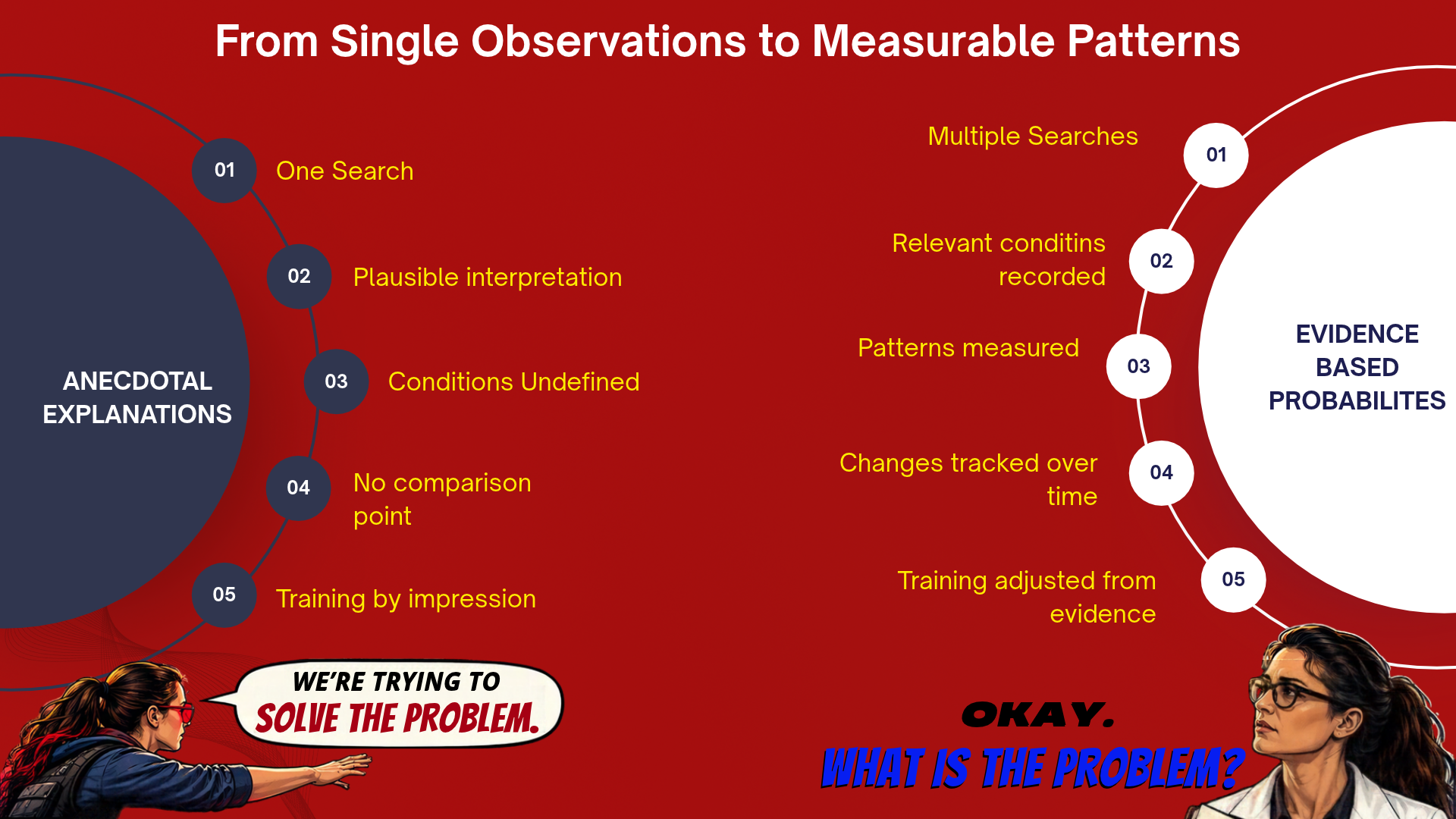
The scouts offer excuses, suggesting he just needs 400 at-bats to prove himself. When the head scout defensively insists, "We're trying to solve the problem," Billy immediately counters: "Okay, what is the problem?"
The scouts offer various answers. Billy rejects them one by one. The scouts are trying to rebuild a team using outdated philosophies to replace star players they cannot afford. Billy realizes they cannot win using the old rules; they must define the true problem first.
That scene applies just as directly to detection and scent sports as it does to baseball.
Detection is a highly romanticized discipline. While many handlers keep records, traditional logs rarely do more than validate existing beliefs while ignoring pertinent data.
What Sabermetrics Actually Changed
It is easy to assume sabermetrics succeeded because baseball invented new statistics. That is not what happened.
Baseball had collected statistics for generations—batting averages, RBIs, ERAs, and win-loss records. The sport was not suffering from a data shortage.
The breakthrough came when pioneers like Bill James started asking different questions. Instead of relying on traditional numbers, Sabermetrics identified which specific variables directly drove run production and wins—such as getting on base reliably.
Faced with one of the smallest payrolls in Major League Baseball, Billy Beane and the Oakland A's put those insights into practice. They could not outspend their competitors, so they had to out-think them.
The lesson was not that baseball needed more data; it was that asking better questions exposes critical insights hidden in plain sight.
The Reality of Detection Record-Keeping
Unlike professional sports, much of the sport detection world does not keep structured records. Even handlers who maintain logs often fail to record detailed, objective data.
Without objective tracking, handlers rely on memory, selective impressions, and subjective feelings. This creates several major operational blind spots:
Obscured Proficiency: Handlers cannot accurately evaluate their dog's true proficiency and reliability across varied search environments.
Unclear Impact: It is impossible to see how specific training exercises directly affect real search performance.
Ineffective Diagnostics: Handlers cannot accurately diagnose root causes when issues arise, making targeted fixes impossible.
Unintended Consequences: Without clear metrics, handlers cannot determine whether a new training method actually improves performance, worsens it, or solves one issue while silently creating another.
To move from anecdotal explanations to evidence-based probabilities, record-keeping must focus on answering core operational questions:
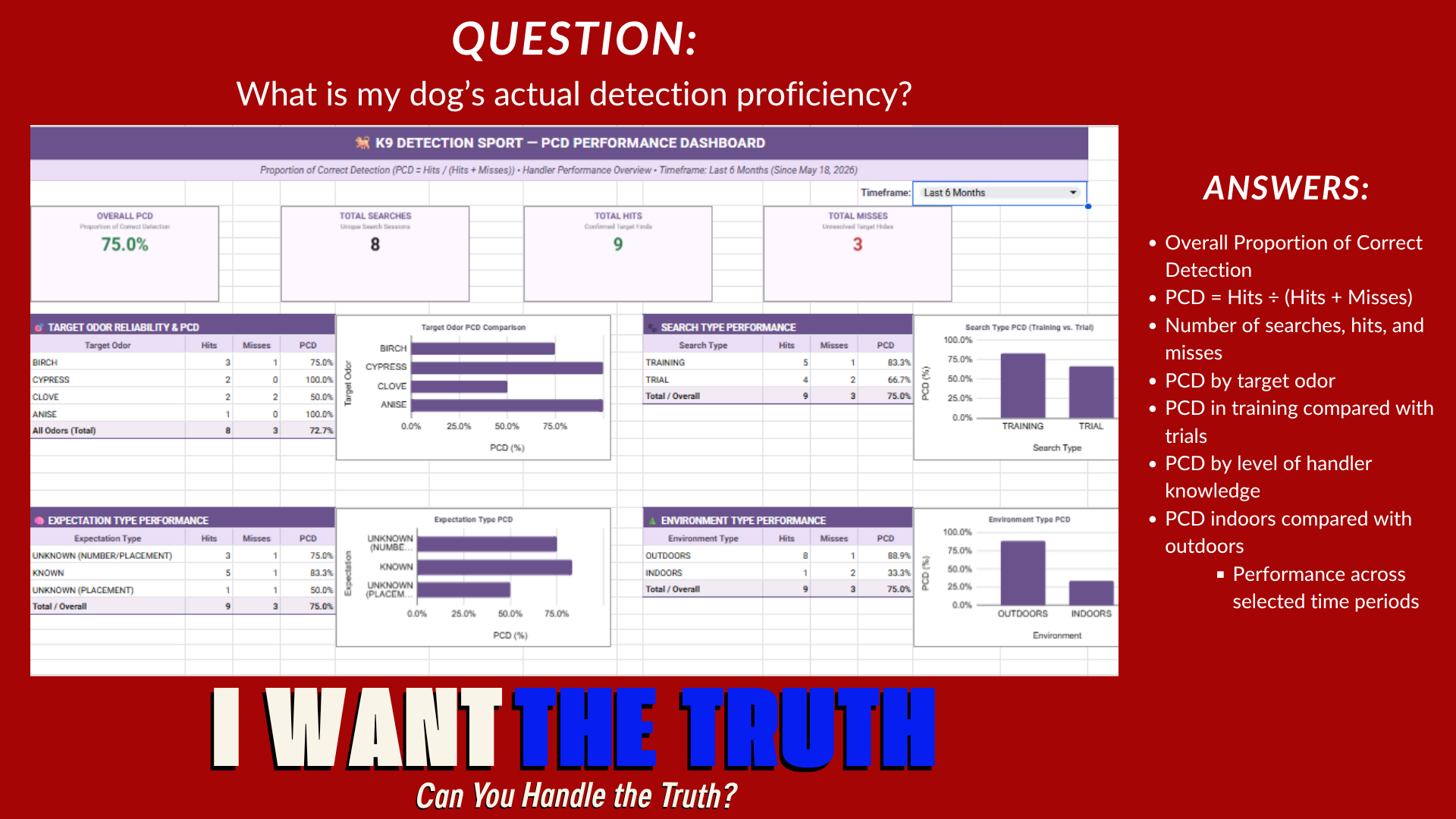
What is my dog's actual detection proficiency?
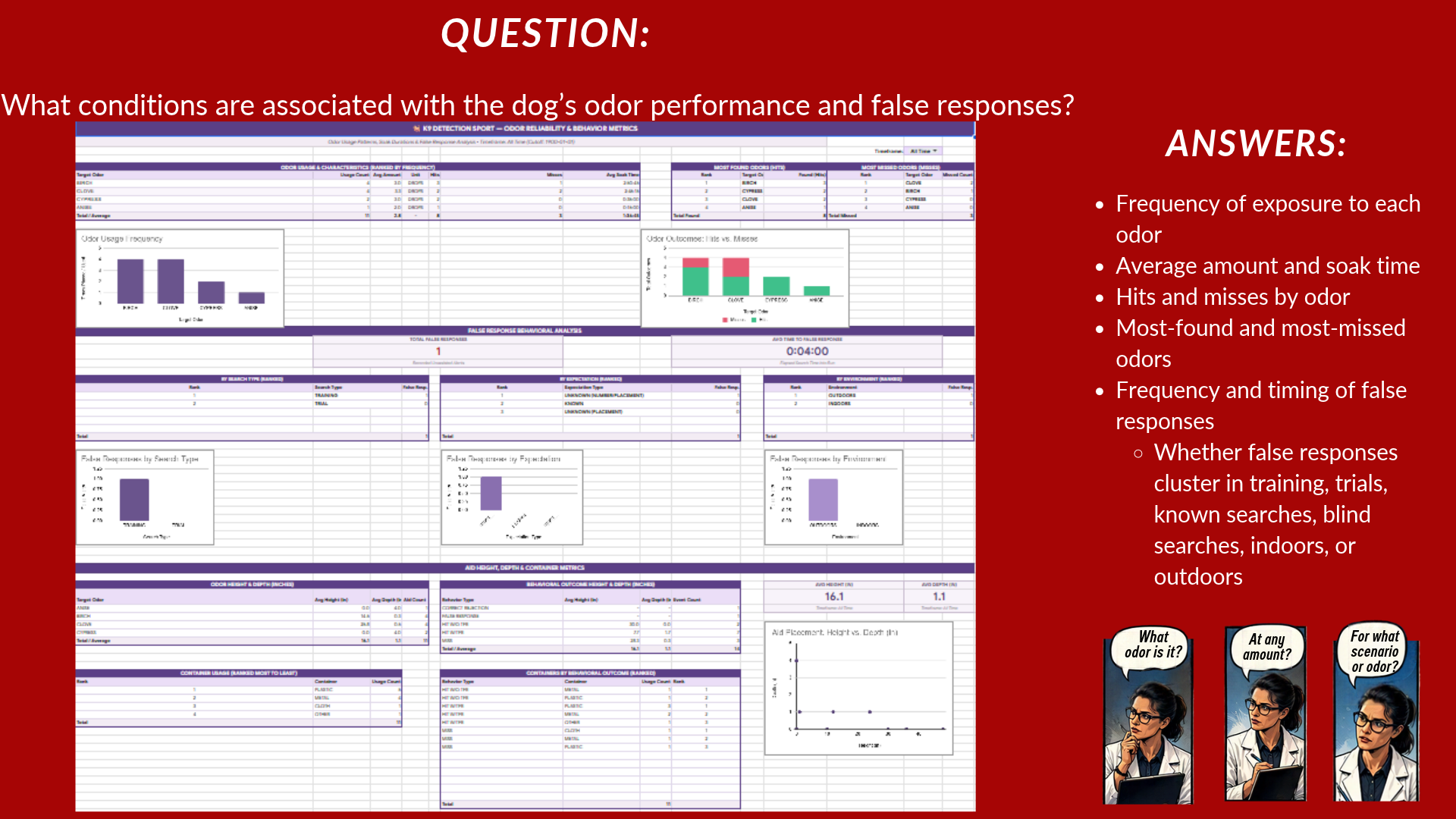
What specific conditions correlate with strong odor performance versus false responses?
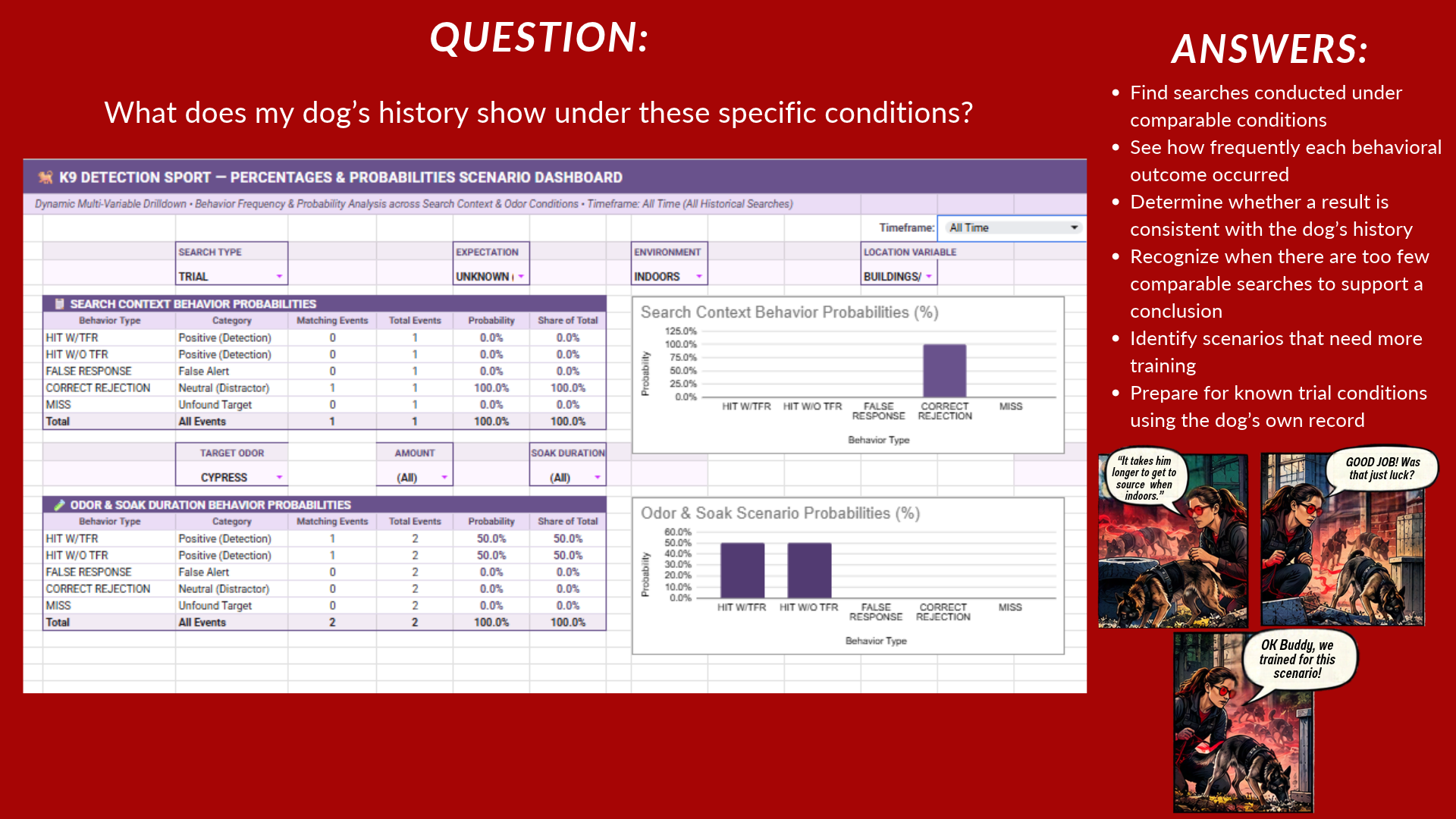
What does my dog's objective history reveal under these exact conditions?
Moving from documenting "what happened" to answering these questions shifts record-keeping from historical logging to active decision-making.
The Question Behind Everything
Whenever someone drew a sweeping conclusion from a single search, my father, Steven D. Nicely, used to ask: "Can you do it again ten more times? With the same scenario? And get the same result?"
He asked this to emphasize the vital importance of recording every meaningful detail—learning what data is necessary versus what yields no actionable insight.
Understanding and documenting these key variables allows handlers to:
Accurately replicate search scenarios.
Design targeted training setups to correct emerging weaknesses.
Maintain and reinforce areas where the team excels.
Without repeated, objective observations under controlled variables, it is easy to mistake a single memorable outcome for a reliable pattern.
Why Memory Is Not Enough
Detection performance is shaped by dozens of interacting variables: environmental conditions, training procedures, reinforcement history, odor dynamics, and subtle changes in both dog and handler.
The challenge is not observation; it is accurately integrating hundreds of observations over time. Human memory naturally prioritizes dramatic moments:
The spectacular, high-difficulty find.
The frustrating, unexpected miss.
The surprising search outcome.
What memory routinely misses are the gradual trends developing over weeks, months, or years. Objective records preserve what memory distorts, allowing us to test our impressions against hard evidence.
Dashboard Insights: Evaluating Actual Proficiency
By calculating the Proportion of Correct Detection (PCD = Hits ÷ (Hits + Misses)), handlers move beyond guesswork. A comprehensive PCD Performance Dashboard provides clear metrics across key operational areas:
Overall PCD: Total Proportion of Correct Detection across all recorded searches.
Search Totals: Exact counts of total searches, confirmed hits, and unretrieved target misses.
Target Odor PCD: Breakdown of detection reliability by target odor (e.g., Birch, Cypress, Clove, Anise).
Training vs. Trial: Performance in training environments compared directly with trial settings.
Handler Knowledge Level: PCD categorized by handler awareness (Known vs. Unknown/Blind searches).
Environmental Comparison: Comparative PCD in indoor versus outdoor search areas.
Time-Based Trends: Performance tracked across customizable timeframes (e.g., last 6 months vs. all time).
Analyzing Odor Reliability and Behavioral Metrics
Diagnosing why a dog succeeds or misses requires evaluating environmental and odor variables alongside specific behavioral outcomes:
Odor Exposure Frequency: How often each target odor is utilized in training.
Physical & Environmental Metrics: Average odor volume, hide height, depth, and soak duration.
Odor Reliability Ratios: Hit-to-miss ratios per target odor to pinpoint most-found and most-missed target scents.
False Response Tracking: Precise frequency and timing of false alerts.
Cluster Analysis: Behavioral analytics showing whether false responses cluster in specific search types (training vs. trial, known vs. blind, indoor vs. outdoor).
Looking Through Time
Proficiency is not static. A dog struggling six months ago may be highly proficient today, while a previously reliable team might be developing an unnoticed flaw.
Analyzing performance across distinct time windows (1 month, 3 months, 6 months, 1 year, or all-time) reveals critical trajectories. This reflects Bayesian reasoning: as new evidence is gathered, our assessment of reliability continuously updates. The goal is not to assign permanent labels, but to maintain the most accurate current estimate of performance based on evidence.
Distinguishing Patterns from Luck
Was a successful search the result of high skill, favorable wind, or pure luck? Was a miss an isolated mistake or part of an emerging weakness?
By cross-referencing historical records under comparable conditions, handlers can ground their evaluation in empirical evidence rather than speculation. While data cannot eliminate uncertainty, it replaces guesswork with objective probabilities.
From Historical Records to Trial Predictions
Multi-variable drilldowns allow handlers to translate training logs into actionable predictions for competition:
Contextual Lookups: Instantly locate historical searches conducted under matching environmental and odor conditions.
Outcome Frequencies: Track exact frequencies across all five outcome categories: Hit w/ TFR, Hit w/o TFR, False Response, Correct Rejection, and Miss.
Consistency Audits: Determine whether a search result reflects luck or aligns with historical trends.
Sample Size Evaluation: Recognize when too few search records exist to draw a valid conclusion.
Targeted Preparation: Identify specific weak scenarios requiring focused training before trial day.
Objective Trial Strategy: Approach competition conditions backed by the dog's documented track record.
The Workbook Is Not the Trainer
Graphs, percentages, and statistical probabilities provide powerful insights, but data does not interpret itself.
A workbook can reveal that performance shifted, but understanding why still requires expert knowledge in:
Behavioral science and learning principles.
Reinforcement schedules and odor dynamics.
Environmental influences and handling mechanics.
Analytics serve as a diagnostic guide, not an automated instruction manual. When data reveals a trend, the trainer must ask: What needs to change? And once a training change is made: Did it produce the intended result?
Why It Requires Commitment
The value of any record-keeping system depends entirely on the integrity of its data.
This requires discipline and honesty. Misses, false responses, and unexpected failures must be logged as meticulously as successful finds. Objective records are valuable precisely because they reveal facts we might otherwise prefer to ignore.
Conclusion
Baseball did not transform because someone invented statistics; it transformed because people started asking different questions.
Sport detection stands at the edge of a similar evolution. Achieving true reliability requires:
Standardized operational definitions for hits, misses, false responses, and correct rejections.
Consistent logging of scenario, odor, and environmental variables.
Understanding how these variables interact so search scenarios can be recreated accurately and targeted in training.
A single successful search proves what happened once; repeated success under identical conditions establishes true reliability. By capturing complete records and learning how variables interact, handlers can design purposeful training setups that turn historical logs into predictable competition success.
Before we look for answers, we need the right question.